Key Takeaways:
GenAI has shifted from being a Hype to a Strategic Necessity: Enterprises could no longer afford to have Generative AI as an option. It has become an absolute necessity to be able to compete, achieve measurable returns, and change the way organizations create value.
Productivity, Speed, and Context are the New Performance Parameters: GenAI is speeding up productivity and decision-making for teams via autonomous AI agents. It aids contextual understanding of decision variables, so that teams can work with speed and agility in real time.
Data Strategy and Governance Define Enterprise-Scale Success: Internal data that is trustworthy and AI-generated inputs with strong governance frameworks are most important in lessening risk, building trust, and steadily rolling GenAI out across business functions.
The Long-term impact is achieved when People, Technology, and Business Intersect: When organizations blend data readiness, skilled talent, responsible AI controls, modern infrastructure, and business integration in a coherent structure, the long-term impact can be measurable.
The moment for Generative AI has moved decidedly past the hype into competitive reality. Gen AI is no longer just a technological option; it is now a fundamental strategic imperative for competitive survival. To survive, enterprises will need to start using it in securing financial freedom.
GenAI has proven its capability to maximize organizational performance and hence the pressure to adopt it. The technology answers the call for radical improvement in productivity levels. According to Deloitte, 74% of advanced initiatives are already meeting or exceeding their Return on Investment (ROI), thereby proving GenAI is truly reimagining and accelerating the value-creation process.
An enterprise wishing to remain relevant must subscribe to such extent of transformation. The stakes are very high: McKinsey estimates that GenAI can potentially generate an additional annual value of $2.6 trillion to $4.4 trillion on a global scale. To not have a proactive GenAI strategy would mean consciously letting this economic advantage go, thereby sealing the organization into oblivion. Adoption is not about the long-distant future anymore; its about an emergency response to an immediate need to transform core workflows and secure position into an economy transitioning into its next phase.
|
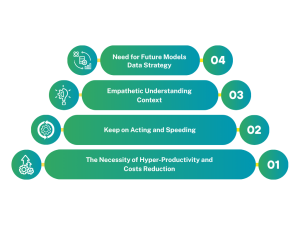
Key Drivers of GenAI Adoption
1. The Necessity of Hyper-Productivity and Costs Reduction: In an era when enterprises are subjected to severe efficiency pressure, GenAI opens up a completely new frontier. With GenAI, productivity will increase to hyper-productive efficiency, while the time spent on doing various day-to-day activities will reduce. This recovered time can be utilized by focusing on much higher-value work such as thinking strategically and doing creative tasks. The effect of these efficiency gains is immediate conversion into operational cost reductions, which will push organizations to rapidly upskill their workforces.
2. Keep on Acting and Speeding: However, the onrush requires that decisions should be oriented to definite goals in real-time, beyond all the traditional automation. The massive use of Agentic AI should logically follow. Agentic AI comprises a system that is capable of autonomously planning and executing complex tasks. Deloitte estimates that by 2025, 25% of organizations that embraced GenAI would probably provide AI Agents, accelerating and scaling processes without much human support.
3. Empathetic Understanding Context: In this way, you would have to achieve a condition through which the biggest challenges are interpreted and deciphered in mere moments without the need for a technological advantage. Moreover, a multi-modal solution for customer experience, as well as advanced RAG systems covering various interpretations from types, such as text, images, and audio, is needed since the context is crucial for building hyper-personalized experiences and rapid product changes through true customer and market sensing.
4. Need for Future Models Data Strategy: It has been argued that, given the exhaustion of and concerns over public data quality, the pure reliance on public data is not sustainable. Such pressure despite the strategic compulsion has led enterprises to build strong internal data pipelines. Synthetic data-a form of realistic data created by AI-is fast becoming a strategic asset to provide scalable, predictable availability of high-quality training data for proprietary next-generation models, particularly under conditions of uncertainty.
Key Challenges & Risks to Master
Scaling and embracing new approaches responsibly is not an easy task-it entails enormous risks to be managed much ahead. Not that a lack of technology is concerned; it is only about organizational and governance issues-
- Infrastructure Gaps: GenAI has to be fed with clear, consistent blast-fast information that it could easily access and govern, but the primary barriers debarring the performance capability of the model and its trustworthiness even before go-live are data quality, access issues, and bad infrastructure.
- Trust and Ethical Risks: Most regulated industries will not allow any wiggle room regarding high-stakes issues like explainability in systems, bias, and compliance processes. Failure to exert strong control brings in monstrous existential legal and ethical risks.
- Fragmentation and Scaling: The pilot paradox, is where good ideas die an early and costly death, and do so only to create fragmentation within the organization,-drug-kicking, and then lack of translating proven value to enterprise-wide impact.
- Cultural Resistance: There are human aspects of effective transformation. Employee adoption will be communicated cured from fears of a job being replaced by AI, perceived as augmentation or upskilling and not replacement.
- Model Hallucinations and Reliability: GenAI possesses one of the most formidable threats against its reliability-having the capability of generating information that is not factually correct but very believable. Consequently, unreliability puts the organization into horrible legal liability and financial loss, as well as damage to its reputation, if the task becomes critical.
An enterprise mastering responsible and structured GenAI adoption will unlock tremendous and unprecedented value, thereby creating a new sustained source of competitive advantage. A governance-first approach is needed to ensure a systematic shift from enterprise-wide experimentation to transformation.
|
|
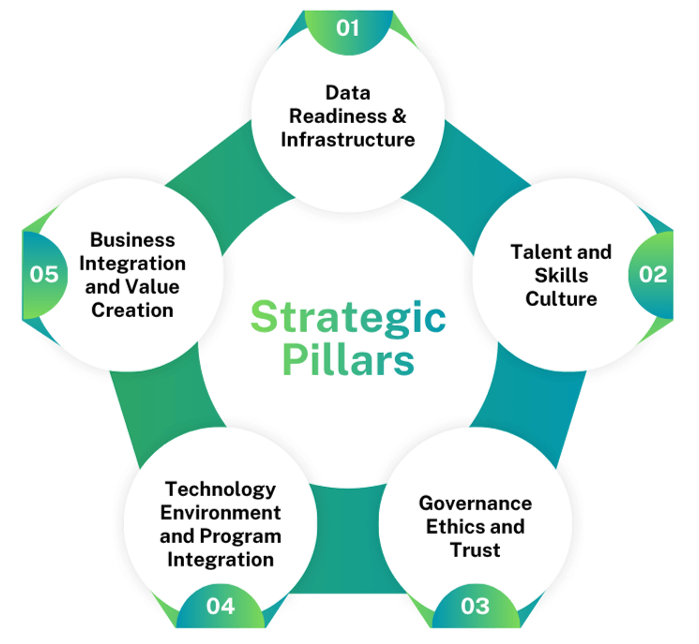
Strategic Pillars
Because this is a huge broad change, it’s not easy to do. As such, we have a Five Strategic Pillar framework for realizing the full enterprise-wide change. Cross-cutting through these five pillars are the enablers and guardrails across every phase of the adoption roadmap. They build the structural integrity, talent readiness, and ethical mandate required to ensure GenAI delivers scalable value; i.e., not unmanaged risk and poor organizational stability.
Data Readiness & Infrastructure
GenAI relies completely on clean, accessible, and well-governed enterprise-wide data. This pillar focuses on the management of data and what it defines as genuinely “Generative AI-Ready.” This means integrating data from all sources (structured and unstructured, from sales records to video), establishing clear master data policies, and securing the necessary cloud or hybrid infrastructure to train and run models efficiently. The greatest challenge is unification of fragmented “dark data” silos in order to achieve the built data assets that GenAI needs to perform itself efficiently.
Talent and Skills Culture
The most that technology will do for any organization is dependent on the people who use and manage it. This pillar addresses the “Skills and Experience” needs of businesses concerning use of technology across business leaders and technical teams. This means building literacy programs, creating a network of “AI champions” for organic adoption, and introducing specialized roles like Prompt Engineers and LLMOps teams. This is most important because it brings about cultural change by introducing GenAI as an augmentation tool to gain acceptance from the employee and break resistance.
Governance, Ethics and Trust
Responsible AI is a scaling need. This pillar gives the guard rails and risk taxonomy that cover privacy, bias, intellectual property, and compliance across all GenAI uses. In fact, a Unified Control Framework (UCF) is required so that it can align the internal rules with the changeable global regulations-the “mountainous volume of rules”. The focus here is mandatory auditability of models, along with explainability and continuous monitoring to ensure that trust is maintained both with regulators and customers alike.
Technology Environment and Program Integration
An environment stands on technology, which is most effective against technology. If technology wishes to stand alone, the option with the operationalized AI is also available. In balance, it is defined with regard to the other value beacon of GenAI that it be the gate of agility and permissive control; thus, under conditions that would be centralized or decentralized or federatively applied. Also, causing GenAI capable architecture, or are that it entails the provision as follows from genomic library of infrastructure by requiring secure and clustered GPUs/cloud for computational capacity, and well-defined LLMOPS pipelining to carry manage lifecycle operations, continuously observing performance and cost and reliability parameters to keep the pilot moving attending on interfacing easily with already established enterprise platforms and applications.
Business Integration and Value Creation
This is where the relationship between the GenAI initiative and the broader enterprise objectives is aligned-not as a loose technocratic project in a vacuum. Consequently, the pillars of the GenAI initiative Change Management and Adoption fall in the period of crystallizing the executive management among factions behind it, and creating, executing a structured stage-gate process with delineated phased progress, formulating high-value pilots of their verifiable demonstration, and early wins. Very important will be organizational successes which ensure user touchpoints, rather informally put throughout discussions, and user engagement through better retention, diffusing AI-enriched workflows through daily organizational life.
GenAI Use Cases
With generative AI, the very paradigms of the business environment will be torn apart, as not only does it change the way things are done at present, but also adds one of the most different values to a business. The greater understanding of the trends of adoption, the deeper transformational opportunity can possibly lie for any sector across the world towards equally important transformational use cases that bias towards operational improvement and, in turn, competitive differentiation. This GenAI case study manifests that we are also at the cutting end of this transformation-how we prove our mettle in partnering with large corporations to translate a strategic vision to real outcomes within mission-critical functions.
- A Supply Chain Technology company of industry-leading fanfare engages us to automate parcel spend management by a GenAI-generated conversational agent. Natural language processing is interpretable as good, simple querying over usually complex logistics data. Querying insights, forecasting, and results visualization happens in real time, largely augmented customer experience, less complexity of data, and a quicker, well-informed decision-making process at all sections of the supply chain-from automating analytics to enabling access for customers.
- Enriched shopping experience for customers was brought by us with a GenAI-enabled voice and image shopping assistant for a leading Online Fashion Retailer. It could use voice commands, a smart outfit recognition feature, and an AI-driven shopping cart management to offer personalized context-aware recommendations. And most importantly, the intuitive, hands-free discovery and purchase of products forms streamlined discovery that lessens decision fatigue while improving involvement and customer satisfaction through smart personalization in real time.
- We automated major aspects of employee training and policy access via a GenAI-enabled conversational assistant for one such entity from the Banking and Finance Industry, which deals with credit unions. Employees can now ask policy-related questions on HR, Finance, and Legal policies through intuitive context-aware interactions, thus saving time and leading to better effectiveness. This adds to an experience of learning and streamlined access to critical information while increasing operational efficiency, driving productivity, and providing employees with quicker and easier access to decision guidance.
- We helped the Travel and Hospitality Industry accelerate customer query resolution with a GenAI-powered conversational assistant. The solution leveraged historical tickets and knowledge documents to provide agents with context-aware responses in real time. By automating information retrieval and streamlining ticket handling, it enhanced operational efficiency, reduced resolution times, and improved customer satisfaction across service operations.
Read Case Studies: AI & GenAI in Action: Real-World Case Studies of Transformation
|