|
Key Takeaways: Golden Record Management increases the value gained from the manufacturing industry by eliminating fragmented data and providing sales teams with a clear, unified view of customers, products, and revenue opportunities. Consolidated siloes and inconsistent data unfold hidden revenue opportunities. This ensures account valuation, targeted cross-selling, and customized sales engagement within the comprised customer base. Pimcore Master Data Management (MDM) solution creates fast and apt Golden Record Creation with smart deduplication, data conflicts resolution, and multi-domain data governance. Thus, its application guarantees smooth and well-informed M&A integration in manufacturing. |
|
M&A has a huge role in the manufacturing sector regarding overall business strategy. In fact, growing or expanding through M&A now has strategic implications in the technology world. It is not just about integrating balance sheets, but integrating operations and, most critically, integrating the right data. The main purpose of M&A in Manufacturing is to create immediate revenue synergies. However, sometimes IT integration delays this. Sales teams responsible for achieving combined revenue targets work with two siloed, conflicting, and incomplete data sets (Customer, Product, etc.). This is where establishing a Golden Record comes into play. What is Golden Record Management?Golden Record is the single most complete and trusted version of a data entity, such as a consumer or product, created by merging, cleansing, and streamlining data from different systems. Further, the golden record management is a process that removes data silos, improves data quality, and enable better decision-making. A successful golden record management strategy provides the sales team with the real-time and unified data, needed for identifying and pursuing new business opportunities. |
The M&A Data Challenges for ManufacturersManufacturing M&As presents a unique data complexity, circling around key domains such as Product, Customer, Supplier/Vendor, and Location/Asset. Before any integration, the two merging companies operate with parallel universes of data. This creates a data void during the crucial post-merger period. At that point, the reliance on only ERP migrations can cause slow, costly, and conflicting data sets.
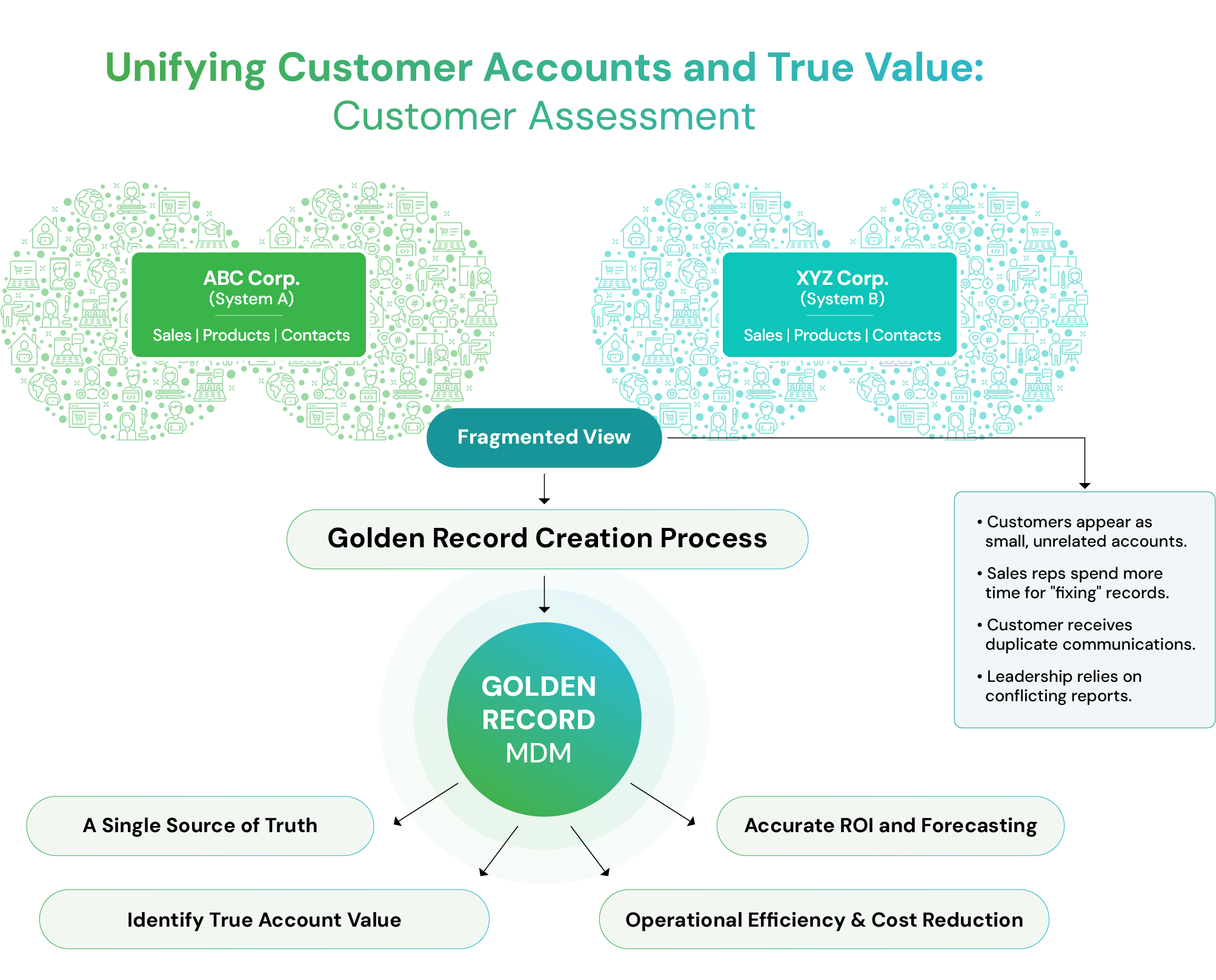
The Challenge: The combined sales team functions with two different and fragmented data universes in the following manner:
Moreover, it can further prevent the combined sales force from seeing the True Account Value and immediate Cross-Sell/Up-Sell opportunities The traditional method of M&A implementation involves an elaborate and expensive process of migrating the entire data into a single, unified ERP system, which is typically slow and does not offer a true image of the consolidated data. After an M&A, the expectations are always high for immediate realization. This is where the Golden Record approach serves as the strategic solutions. |
|
Finding New Opportunities with Golden RecordsHaving duplicate customer records is a challenge that arose as a result of the merger and acquisition where the acquiring company and the acquired company sold similar products to a prospect but treated them as two separate entities. Golden Record Management Strategy turns these separate entities of information into a direct revenue generator. It diverts the necessity for a full, slow ERP migration by acting as a translation layer that quickly creates a single source of truth, the Golden Record, for key domains (Customer, Product, Supplier, and more).
Customer Golden RecordData is pulled from all applicable source systems, and then an intelligent matching and deduplication process (based on customer ID, address, contact) is performed to merge duplicate records (e.g., “ABC Inc. (Acquirer)” and “XYZ Corp. (Acquired)”) into a single, unified view. Impact: This will automatically reveal the customer’s True Combined Lifetime Value, justifying dedicated strategic resources.
|
|
Product Golden RecordGolden Record is the most accurate and unified view of the product and standardizes the product/material considered; part numbers, technical specs into a standardized data model. Effect: By integrating the Customer Golden Record with the Product Golden Record, the sales team can execute the following actions:
The major value from Golden Record management comes from consolidating fragmented customer information into a single “Customer 360-degree View.” The unified record gives an apt assessment and a better sales pipeline. |
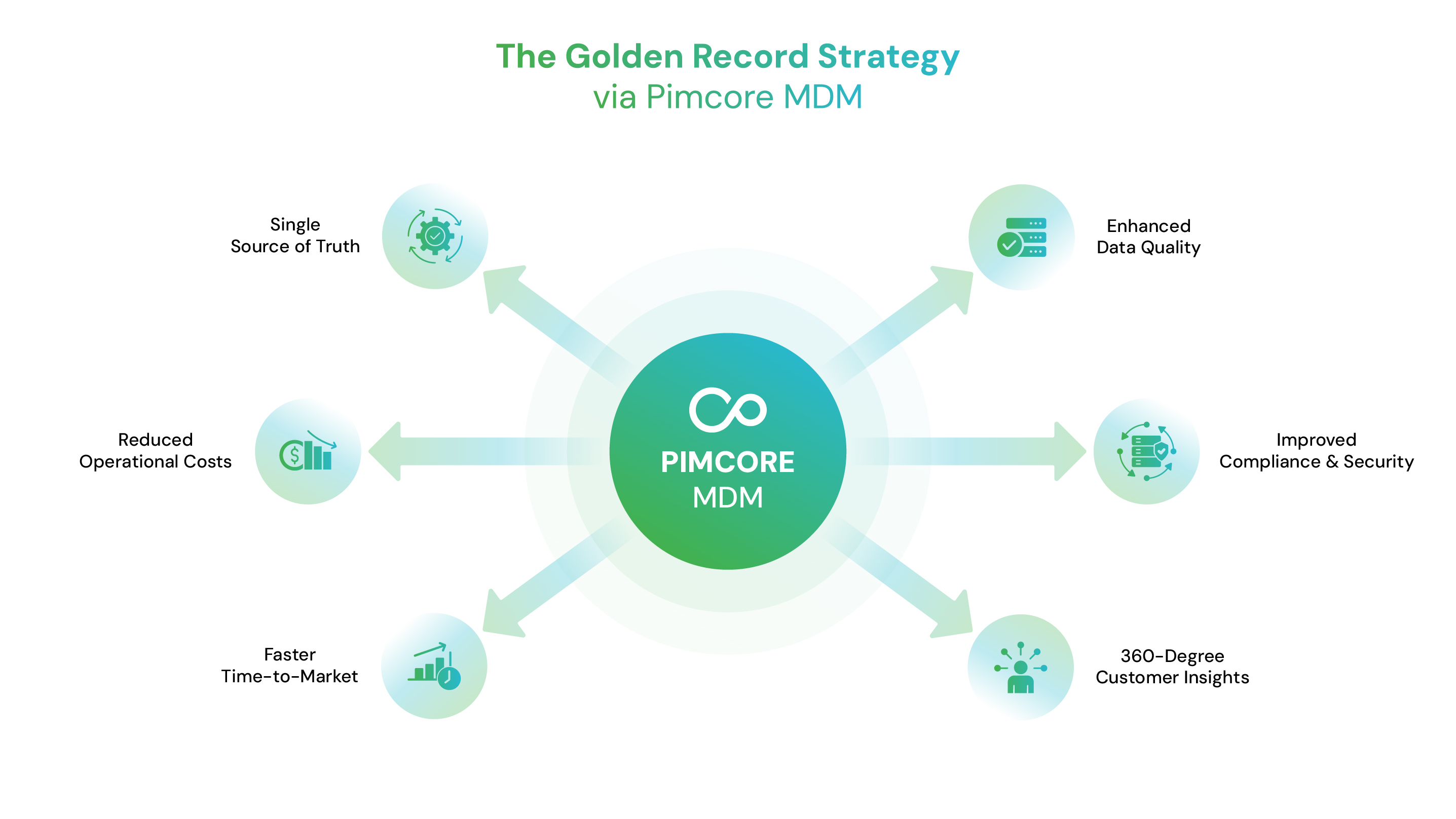
Why Choose Pimcore MDM for Building Golden Record Management Strategy?MDM solutions are the primary tools to achieve golden record management. Pimcore offers an integrated platform for Product Information Management (PIM), Digital Asset Management (DAM), and Master Data Management (MDM) to tackle any data challenge for manufacturers. This integrated capability provides unique advantage in manufacturing M&A. 1. Easily Establish the Multi-Domain MDM Hub You can make use of Pimcore immediately and risk-free as the central data hub acting as a translator layer between the legacy systems of the acquired and acquiring companies.
2. Powerful Features to Create Golden Records The key to the strategy is that it leans on the Pimcore powerful data quality and workflow features to enforce data governance and deliver the single source of truth:
a. Customer Rule Example: When merging “ABC Inc. (Acquirer)” and “XYZ Corp. (Acquired),” the rule might be: Prioritize the Acquirer’s Customer ID, the Acquired company’s most recent address, and the combined, reconciled transaction history. 3. Strong Data Stewardship Workflow Pimcore’s workflow engine helps you create your own Data Steward for any given record if there is a low-confidence match or a conflict of concern. There will never be a bottleneck during data accuracy checks. Also Read: How Pimcore Platform Spells Innovation for Your Business? |
|
In What Way Does Pimcore Aid Sales Teams?Once the Golden Customer Record is created and harmonized across the joint sales teams’ CRM, it opens up an entire universe of new lucrative opportunities: First Use Case: Discovering Actual Account Value A typical sales rep usually deals with accounts according to what is apparent from their historical CRM. The Golden Record immediately fixes this misinformation:
Benefits:
Second Use Case: Product Gap Analysis | Strategic Cross-Selling and Up-Selling The combination of Pimcore’s PIM (Product Golden Record) and MDM (Customer Golden Record) constituents then emerges as the sales teams’ most potent weapon.
Third Use Case: Improved Customer Experience Amidst the post-merger confusion, consistency avoids customer turnover.
Read Success Story: The Unified Golden Record for Products, Customers and Vendors |
ConclusionYou won’t get real value from mergers and acquisitions unless your people can capture the combined data synergies over time. When your data integration process is slow, the result can be costly returns, delayed new initiatives, and additional operational work. To cut through the barriers and accelerate your mergers and acquisitions value, you have to ensure the combined entity realizes its revenue synergies quickly, turning the M&A from a data integration challenge into a powerful competitive advantage. A robust Golden Record Management is the front-line enablement for the sales team during a manufacturing M&A. Want to discuss how Happiest Minds can help you with the Golden Record Management strategy for more accurate sales pipeline? |