Key Takeaways:
“Golden Record” for Business Value: MDM forms a trusted Golden Record that breaks down data silos, drives data consistency, lowers operational inefficiencies, and drives faster time-to-market.
Types of MDM Implementation Style: Organizations select from four MDM styles relying on their architecture, such as Consolidation (centralized reporting), Registry (virtual indexing), Coexistence (shared hub and source updates), or Centralized (hub as the primary system of record).
Strategic Selection Factors: Choose the right MDM style depending on business objectives, data maturity, and analytical vs. operational priorities, in addition to IT landscape complexity and data governance maturity required for compliance.
Accelerating MDM with Generative AI: GenAI significantly amplifies master data management outcomes, allows faster data standardization, automated governance, and greater realization of business value.
|
|
Master data management (MDM) for product data and customers continues to be an important area of focus for enterprises. An MDM platform helps organizations build a trusted view of their data by offering uniformity, accuracy, stewardship, semantic consistency, and accountability.
In the age of AI, achieving success in master data management is not only linked with the MDM platform selection, but also knowing how to implement it with the right style and approach. This insight talks about various MDM implementation styles. By understanding various styles, you can better deliver the functionality required to support your business objective.
|
How an Ineffective MDM or No MDM Can Affect Your Business
If MDM is not aligned with the organization’s business goals with data-driven maturity and ambition, the consequences can severely impair the business outcomes.
For instance, a retail business that needs to shift product categories plans rapidly with increasing price and margin pressures, but struggles to make decisions on what to sell or drop because of data quality issues.
Or consider a manufacturer’s business that has acquired another company. The sales reps from the acquired company are not aware of the strategic enterprise contract held by the acquiring company, resulting in duplicate sales efforts, conflicting price quotes, and inconsistent customer service.
In addition, the typical enterprise scenario, where the accounts department, sales team, and customer service representatives each maintain their own, disconnected customer databases, results in a number of challenges:
- Incomplete and Inconsistent Data: A single customers have different IDs, names, and addresses across different systems.
- Data Silos: When data resides in silos, it is very difficult to determine which version is most accurate and authoritative to use. Ultimately, it undermines trust in data.
- Data Governance Issues: Enterprises face complexities in the business environment because of the absence of data governance, risk management, and control.
- Slower Time-to-Market: Incomplete or contraction of product or customer data can lead to a delay in new product launches and cohesive services.
- Stalls new initiatives: The departments cannot efficiently leverage the critical data, preventing them from taking innovative initiatives for business expansion.
- Increased Operational Costs: The remedial data cleansing actions consume time and budget, impairing organizational efficiency.
Thus, trusted master data sits at the core of these decisions and business agility. In the first scenario, implementing Product MDM, the retailer can consolidate product data to get high data quality and agility to execute rapid product category launches and marketing strategies.
For manufacturers, an MDM solution helps identify, match, and merge duplicate customer records to create a “Golden Customer Record” enabling the sales team to gain a single, accurate view of the entire customer relationship.
Master data management (MDM) is effective only when it is precisely linked with the right use case and business outcomes it supports. However, failing to clearly articulate an MDM project results in repeated efforts that divert budget and time from strategic business goals.
Also read – A case study showcasing “The unified Golden Record for products, customers and vendors” |
How to Apply the Right MDM Implementation to Accelerate Business Outcomes
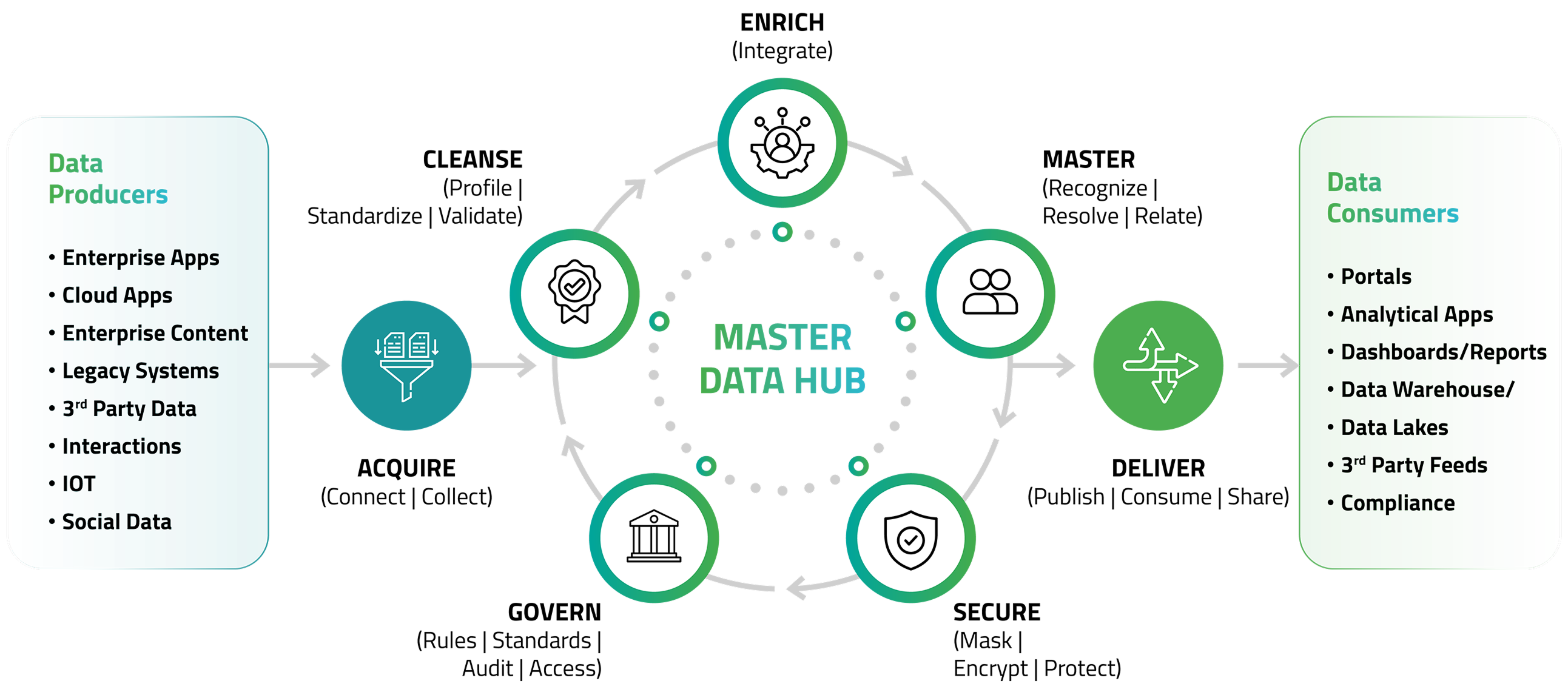
The growing complexity of digital business is driving enterprises toward alternative approaches to traditional data architecture. To mitigate increasing data risks and drive quicker business outcomes, a structured approach is essential. During this process, the right choice of MDM implementation style is the most crucial architectural decision that business stakeholders must make. It helps lay out the right foundation to map out the journey with the right architecture, technology, and process.
You must select a style that aligns with your current IT landscape and business goals. So, before starting the implementation, a primitive understanding of master data management implementation style is important for successful MDM projects. It helps you determine the scope, technical architecture, and system design.
|
The Four Foundational MDM Implementation Styles
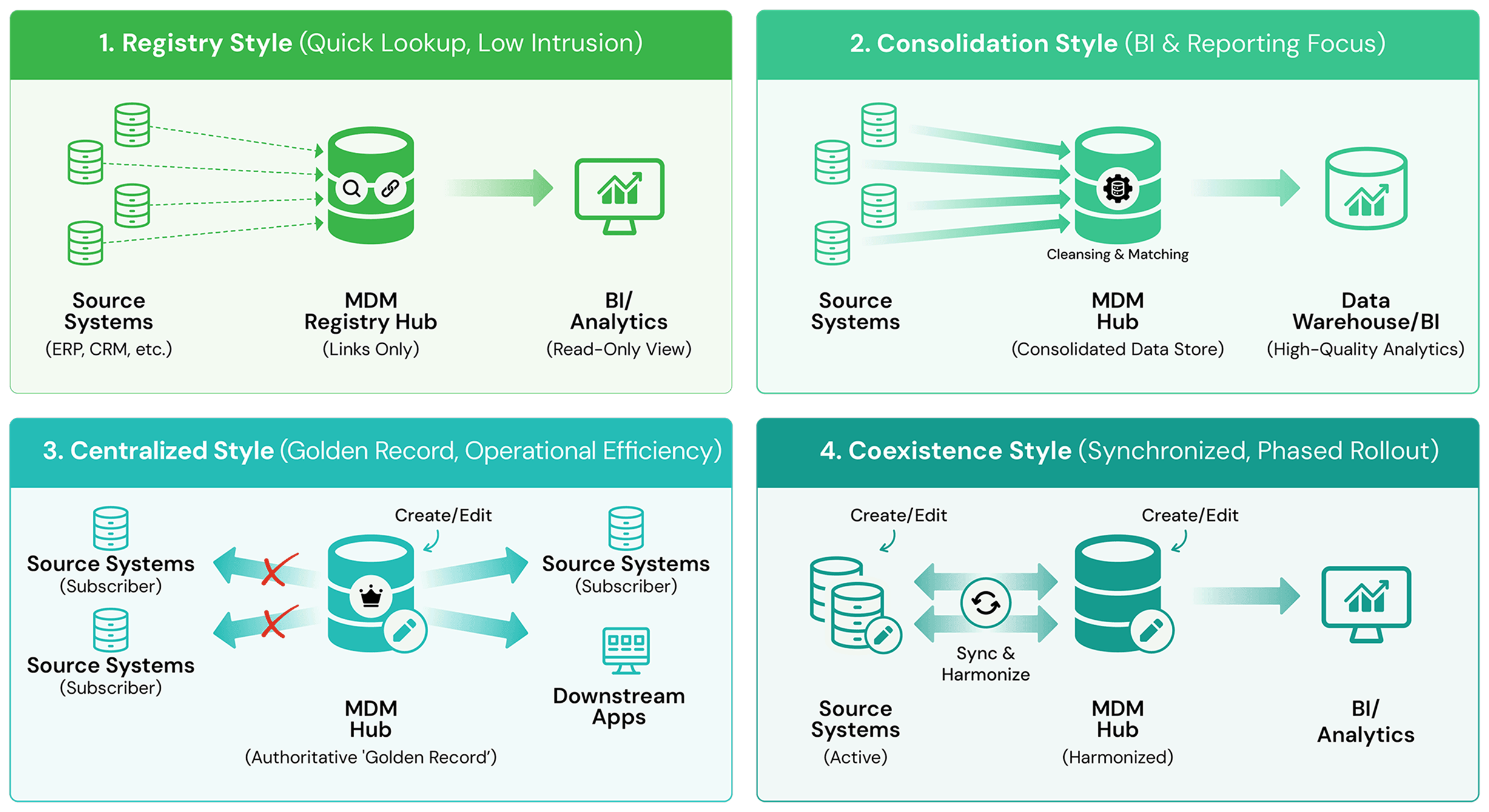
MDM implementation styles dictate how master data is stored, governed, and distributed across the enterprise. They are broadly categorized as Analytical MDM—for reporting/BI purposes and Operational MDM— for transactions/real-time processes.
Style: Consolidation
In this approach, master data is consolidated from different systems periodically from source systems to a data warehouse or an operational data store. The data is not synced back to its original systems, such as ERP or CRM. Consolidation style is also referred to as downstream MDM.
- Primary Goal: BI/Data warehouse
- System of Record: MDM Hub for the consolidated view
- Data Flow: One-way and unidirectional, moving from the source systems to the targeted system
- Best Suited For: Business intelligence, data warehousing, high-quality analytics
Style: Registry
It utilizes a simple database, known as a “registry,” as a cross-reference table to merge identifier data across various operational systems within the enterprise. It is a low-cost and effective approach when you need data for a read-only view.
- Primary Goal: Consistent view/lookup
- System of Record: Source Systems
- Data Flow: MDM is read-only. Data link is there, but remains in the source systems
- Best Suited For: Rapid access, minimal disruption, analytical/reporting needs
Style: Coexistence
It is used when multiple databases containing the master data must coexist as the systems of record for that master data. The key issues are harmonization of distributed/federated rights of authorship.
- Primary Goal: Synchronized, managed data
- System of Record: Both MDM Hub and Source Systems
- Data Flow: Bi-directional synchronization. Master data can be updated in either system
- Best Suited For: Complex environments, balancing operational and analytical needs
Style: Centralized
It establishes a well-managed and governed central repository for master data. This repository holds a set of “golden records” that are accessed in a read-only fashion by all of the operational and analytical systems throughout the enterprise.
- Primary Goal: Create a Golden Record
- System of Record: MDM Hub
- Data Flow: Master data is created and maintained only in the MDM hub, then published out to all other systems
- Best Suited For: High data governance, operational efficiency, organizations seeking the purest “single source of truth
|
Decision-Maker’s Checklist to Choose the Right MDM Implementation Style
The following criteria can be used by decision-makers to identify the best implementation style for maximum business outcome velocity:
- To Prioritize Your Business Outcome
If you need an immediate trusted reporting foundation (e.g., to achieve a single view of the customer for sales analysis) with the least disruption, select Registry or Consolidation style.
If your goal is minimizing transaction errors (e.g., to ensure a manufacturing unit uses the latest product specs) select Centralized or Coexistence style for real-time data accuracy.
- To Build Data Governance Maturity
If your goal is regulatory compliance and industry standards, a centralized approach to data management is required to streamline data governance. It minimizes the risk of non-compliance penalties, data breaches, and reputational risk.
For the long-term state, a centralized approach is best suited to ensure trusted information about critical business assets.
- To Assess the Source Systems’ Complexities
When you are working with multiple critical, disparate, and established systems, the Coexistence style is the most pragmatic choice.
If you don’t need to touch source data, Registry or Consolidation style can serve the purpose, while reducing project risk.
Also read: A detailed insight on what is master data management and why you need it
|
Building a Structured Roadmap to Drive Incremental MDM Success

Regardless of the initial style chosen, MDM success is an incremental journey. Apply a structured and step-by-step approach to quickly realize the master data management benefits with minimal risks:
- Define: Establish vision, strategy, metrics, and governance (including data stewards) aligned with the business leadership and participation from IT professionals.
- Identify Scope: Choose the right implementation style and the initial data domains (e.g., Customer, Product) that work well in your enterprise’s siloed IT landscape to arrive at the right MDM scope.
- Strategic Technology Selection: Drive down total cost of ownership and maximize scalability by leveraging industry-leading tools or solutions to guide key technology decisions. Align your MDM technology choices—including Build vs. Buy, database architecture, data integration strategy, and cloud deployment model—with industry best practices and a robust architecture.
- Execute & Scale: Deploy the chosen MDM style and solution in a series of projects, building the technical foundation.
- Evolve: Measure results and use them to justify the next phase, moving from your current stage as your governance and technological maturity grow
|
GenAI to Amplify MDM Capabilities
With growing role of MDM solutions in tackling enterprise data, speed is key for organizations. This is where GenAI has turned out to be a greater enabler by providing capabilities to execute tasks at high velocity. Adding GenAI capabilities in MDM solutions provides key advantages such as:
- Cleanse, standardize and enrich master data in hours rather than weeks.
- Enhance efficiency, minimize errors and automate manual and repetitive tasks.
- Automate the mapping of new source systems and quickly enforce new data governance policies.
- Accelerate time-to-value for data governance and data standardization.
- Generate deeper insights on complex relationships.
- Protect your sensitive data with greater scrutiny.
|
Pimcore: One of the Most Flexible MDM Solutions
Pimcore is a powerful and flexible digital experience platform that includes a robust, multi-domain MDM component. Its architecture provides the flexibility to support all four foundational MDM implementation styles, allowing organizations to start small and mature their strategy over time.
Key Pimcore Advantages for Enterprises
- Multi-Domain MDM: Manages all critical domains (Customer, Product, Supplier, Asset) in a single location, providing a holistic 360-degree view.
- PIM/DAM Integration: Pimcore offers integration solution of Product Information Management (PIM) and Digital Asset Management (DAM), providing a single hub for data and rich media content (images, manuals, specs).
- Flexibility & Scalability: Its flexible data modeling allows organizations to easily extend their MDM to new domains or complex hierarchies (like product variants), supporting long-term business growth without vendor lock-in.
- GenAI Capabilities: Flexibility to integrate GenAI capabilities and similar advanced technologies. Pimcore Copilot also helps to automate through AI/ML-powered assistance.
Low-cost advantage: Reduce licensing and operating costs with Pimcore’s low-cost MDM solution.
Also read – Master data management use cases by Happiest Minds
|
In Conclusion
The critical takeaway from a successful master data management implementation is that technology choice should not only be the top priority.
Rather, your MDM implementation process should be led by your business goals and outcomes so that your foundational needs can be met at the very outset.
Consider MDM solutions that clearly respond to the rising complexity of businesses and economic difficulties in a positive way, such as higher revenue and lower costs. Pimcore is designed to support the modern, business-first approach.
Would you like to discuss how to start MDM with Pimcore or improve the performance of your enterprise data assets? Schedule a demo with us.
|