
Email has been around for more than five decades now. It began as the most efficient way to send a message across, but somewhere along the way, it quietly grew into something much bigger.
We don’t simply just ‘read’ emails anymore. We track things in it. We remember tasks through it. We manage it. Our inbox is often the place where our tasks (complete or incomplete) and references reside. It has become one tool that we live by today; a subtle companion that demands our attention a little more each day. And because it is always there, we rarely notice the amount of mental space it quietly occupies.
If we reflect closely on our work schedules, the inbox is probably the first thing you open in the morning and one of the last things yo we open in the morning and one of the last things we open in the morning and one of the last things we u check before shutting down for the day. It functions like a workspace—a place where tasks, reminders, and decisions accumulate. Looking back, it’s clear that it was never designed for that purpose. We lean on it because nothing else quite fits the gaps it fills.
The Missing Layer in Email Design
McKinsey once pointed out that professionals spend nearly 28% of their time on email in a week. That’s almost a full day every week spent not on execution, but going around the work. The real cost isn’t in the number of messages. It’s in the interpretation. Every time an email arrives, we mentally convert sentences into tasks, timelines, dependencies; all of which the system itself doesn’t recognise.
- Email is good for delivering information (content) — it gets the message across.
- But email doesn’t support the next step: thinking, processing, and decision-making that needs to happen after reading that content.
From a design standpoint, this opens a much deeper question: Is the problem caused by the way the email application is designed (its UI/UX)? Or the real issue could be something deeper? Email is built around messages and threads, not around tasks, decisions, or teamwork. That makes it hard to manage actual work.
Lately, we observe that modern email apps have added plenty of conveniences, emojis, reaction buttons, predictive typing, and smart replies. They make expression quicker, but they don’t make understanding easier. They polish the surface without touching the underlying structure.
- Maybe the question shouldn’t be “How do we manage email better?”
- Maybe it should be “How can email participate in the work that is hidden in the message?”
Email isn’t broken or failing as a tool; it still works for what it was originally designed to do: send and receive messages. The problem is that the definition of “usefulness” has changed when it comes to business; modern work is more complex, layered, and interconnected (involving tasks, decisions, and collaboration). Email on the other hand hasn’t evolved to match that complexity; its underlying model is still based on simple message exchange, not on managing interconnected workflows. If the last era of email was about transmission, the next one should be about continuity.
A Fresh Outlook at the Future of AI Design for Email
1. When Email Outgrew Its Original Purpose
Email was created to transport messages, not to make sense of them. As collaboration became more interlinked and dependent on shared context, email didn’t evolve at the same pace. We adapted. The tool didn’t.
2. When a Message Becomes a Workspace
Most messages today are not “just” messages.
Inside a mail thread, you can see:
- a task beginning
- a decision forming
- a dependency waiting
Yet email treats all of it as plain text. The real meaning gets lost when the message moves. In design terms, it lacks the ability to carry context from one step of work to the next.
3. The Hidden Cost: Carrying the Meaning Yourself
When tools don’t carry context, people do.
We end up:
- holding interpretations in memory
- switching between tools to rebuild context
- re-understanding everything every time we return
The interface looks simple only because the complexity is sitting inside the user’s head.
4. Why Tasks Shouldn’t Have to Leave the Message
The moment a task needs to leave the email message; to move into a calendar, a notes app or a task manager; the context begins to split. The message stays in one place, the action moves to another, and the connection between them weakens. Continuity shouldn’t depend on memory. If email is to evolve, the source and the momentum of the task should stay together.
5. Where AI Helps Us Think, Not Just Type
The real value of AI in email isn’t speed of typing — it’s clarity.
AI can help the system see what the message contains:
- intention
- state
- urgency
- dependencies
- possible next steps
It doesn’t replace judgment. It simply reduces the cognitive load required to reach it.
6. What This Makes Possible
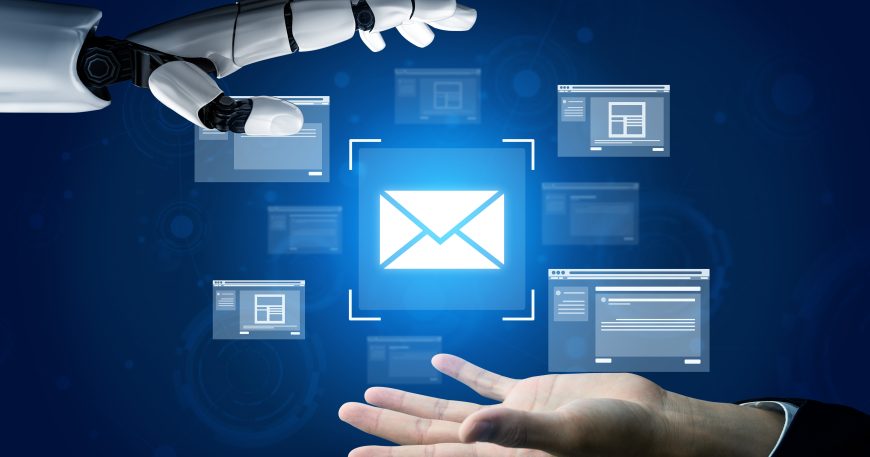
The future of email is a space where context, collaboration, and task flow stay connected, supported by AI that helps the interpretation journey with the message.
Instead of working around the inbox, we work through it.
This is not just an upgrade to email.
It’s setting the foundation for a new layer of work, one where the tools finally shoulder some of the cognitive effort we’ve been quietly carrying for years.