

The healthcare industry is facing a crisis due to administrative inefficiencies and a shortage of clinical resources. According to the World Health Organization, there is a projected shortfall of 10 million health workers by 2030, mostly in low- and lower-middle-income countries. The shortage of healthcare workers leads to poor patient outcomes, including hospital-acquired infections, patient falls, and increased chances of mortality. The global Healthcare market is forecast to grow to 8.3% CAGR from 2021 to 2028, driving investments in scalable healthcare solutions. However, the emergence of Generative AI and Robotic Process Automation (RPA), often deployed through expert RPA services, is transforming healthcare by improving patient outcomes, advancing medical research, and streamlining healthcare delivery processes. In this blog post, we’ll explore the potential of Generative AI in Healthcare and RPA for healthcare to revolutionize healthcare and how they can be combined to transform business operations.
If your organization wants to explore the power of Generative AI and RPA in the Healthcare industry through dedicated generative AI consulting, below are valuable things to keep in mind.
Pain Points of Healthcare Organization (Hospitals report a 15.6% increase in labor expenses)
- Unpredictable business disruptions: – Staffing shortages and burnout, demand volatility, and supply chain shortfalls, which robust healthcare automation solutions can help mitigate.
- Compliance and risk mitigation: – Emerging regulations, transparency requirements, and evolving security threats
- Growing market threats: – New care delivery models, new emerging players, and mergers and acquisitions
- Rising cost pressures: – Inflation, increasing wages, and healthcare consumerism, driving the demand for cost-effective RPA services.
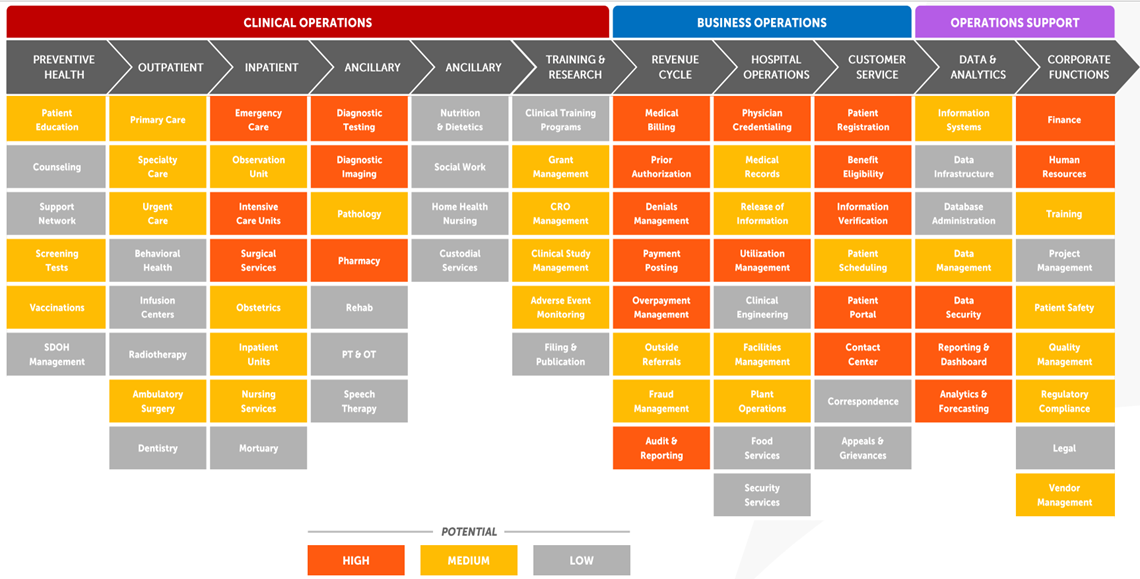
Prioritization of RPA Automation Scope Automation Capabilities
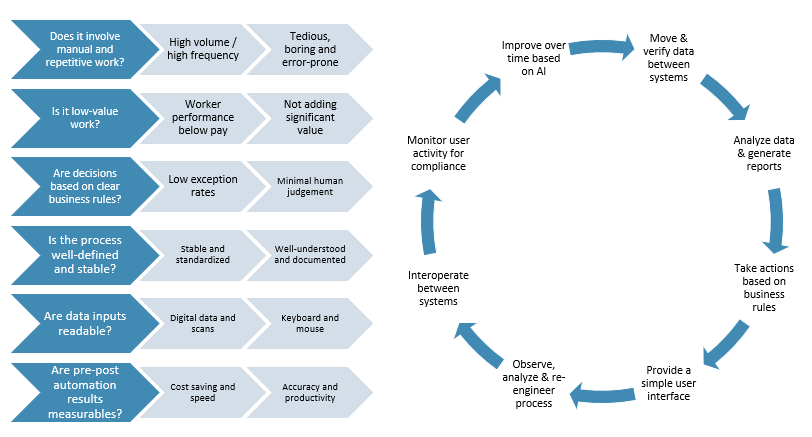
Functional Heatmap for Healthcare Automation
In healthcare, there is automation scope for RPA for healthcare in various segments such as clinical operations, business operations, and operations support, creating an ideal environment for healthcare automation solutions. Below are areas where there is a potential for automation through targeted healthcare solutions. There is a high scope of automation in business operations and operations support such as medical billing, payment posting, finance, human resources, data security, etc., where specialized RPA services shine. However, with the emergence of Generative AI and guidance from generative AI consulting, we can leverage the RPA in other processes as well.
The algorithms used in generative artificial intelligence produce unique and realistic content, including text, photos, music, and videos. Large language models (LLMs), which are used by algorithms, are built by learning from colossal volumes of unlabeled data. The brain is a generative AI in healthcare. Robotic process automation (RPA) is the muscle—the arms and legs of RPA for healthcare to carry out tasks based on insights from the brain.
Data Synthesis: – Create customized summaries of patient care for particular uses, simplify complex care scenarios, examine population health data, produce research materials, aid in the development of in silico drugs, and forecast risks to patients, providers, and payers, a key focus area in generative AI consulting.
EHR Abstraction: – Reduce clinical research burden, enable QA and UR evaluations, analyze value-based metrics, abstract medical information, enable early detection, and find quality and compliance deficiencies using RPA for healthcare.
Patient Experience: – Provide personalized solutions to patient questions, patient education, contextual self-service, make use of SDOH data, preventive health advice, and assistance powered by Generative AI in Healthcare.
Clinician Experience: – Gain knowledge about the condition of the patient, create patient communication, use NLP to help, swiftly prioritize activities, support trial administration, and take advantage of individualized medical education, supported by advanced healthcare automation solutions.
Operations: – Increase exception handling, improve revenue cycle management with RPA for healthcare, and give users in HR, credentialing, finance, discharge planning, lab, and pharmacy access to natural language user interfaces.
Cyber Security: – Develop preventive measures, detect vulnerabilities, and recognize and stop cyber security threats. Constantly enhance performance based on exposure and experience.
Simulation: – Simulations can be used to test organizational models, simulate unexpected crises, estimate the effectiveness of the health care system, and simulate scenarios for informed consent, agents as avatars for some patient interviews, learning from simulated patients, and HR scenarios including hiring, firing, and performance reviews, often developed alongside generative AI consulting teams.
Decision Support: – Receive decision support based on patient history and behavior, take into account variables like SDOH and public health, enter the most recent data or proprietary data to improve AI recommendations, and prioritize activities in challenging situations or when dealing with new patients, a process easily streamlined by professional RPA services.

is a Business Analyst at Happiest Minds with extensive experience in business analysis and identifying and implementing RPA solutions for organizations. He has a keen eye for analyzing business processes and converting them into automation opportunities. Rijan is a great team player who believes that technology can transform complex business problems into simple solutions. He holds a Master’s in MBA (Business Analytics) and a Bachelor’s in BCom (Accounting and Finance).