


Introduction
This solution presents a fully local, offline‑capable industrial Edge AI approach designed for real‑time motor health monitoring and predictive maintenance. It operates without cloud dependency, ensuring uninterrupted analytics in isolated industrial environments. The system delivers actionable insights for safety, reliability, and operational efficiency.
System Overview
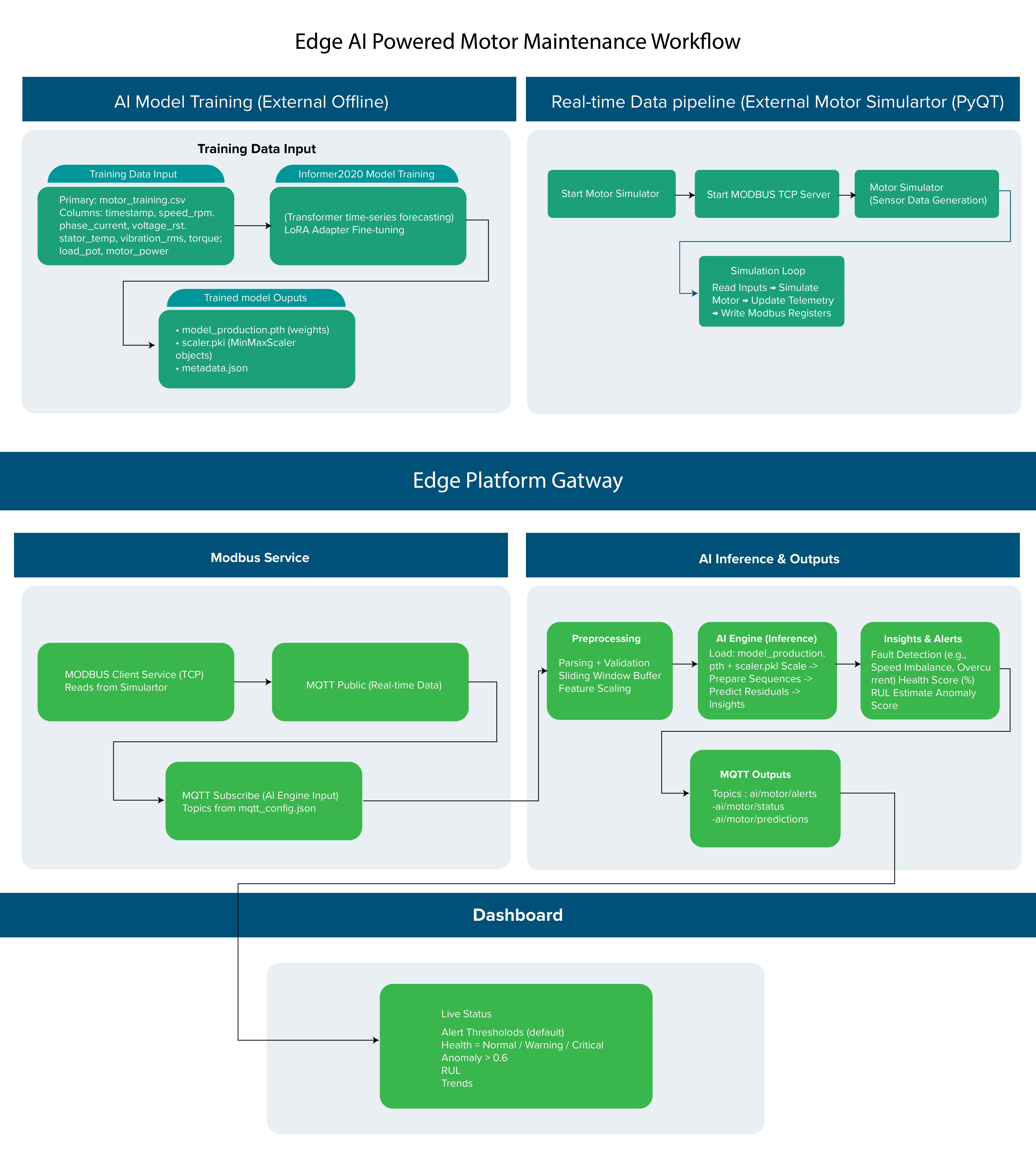
AI Techniques Used
- Transformer-based time-series Informer2020 model for forecasting and anomaly detection.
- LoRA fine-tuning for fast, lightweight motor-specific adaptation.
- FFT/STFT and statistical feature engineering for vibration diagnostics.
- Hybrid AI + rule-based system ensures explainability and safety.
- Health‑score and RUL‑based evaluation of motor performance.
LoRA Fine-Tuning of AI Model Approach
- Base transformer model remains frozen during fine-tuning.
- Low-rank adapter matrices inserted into attention layers.
- Only adapter parameters are trained, enabling rapid customization.
- Produces accurate motor-specific predictions with minimal computation.
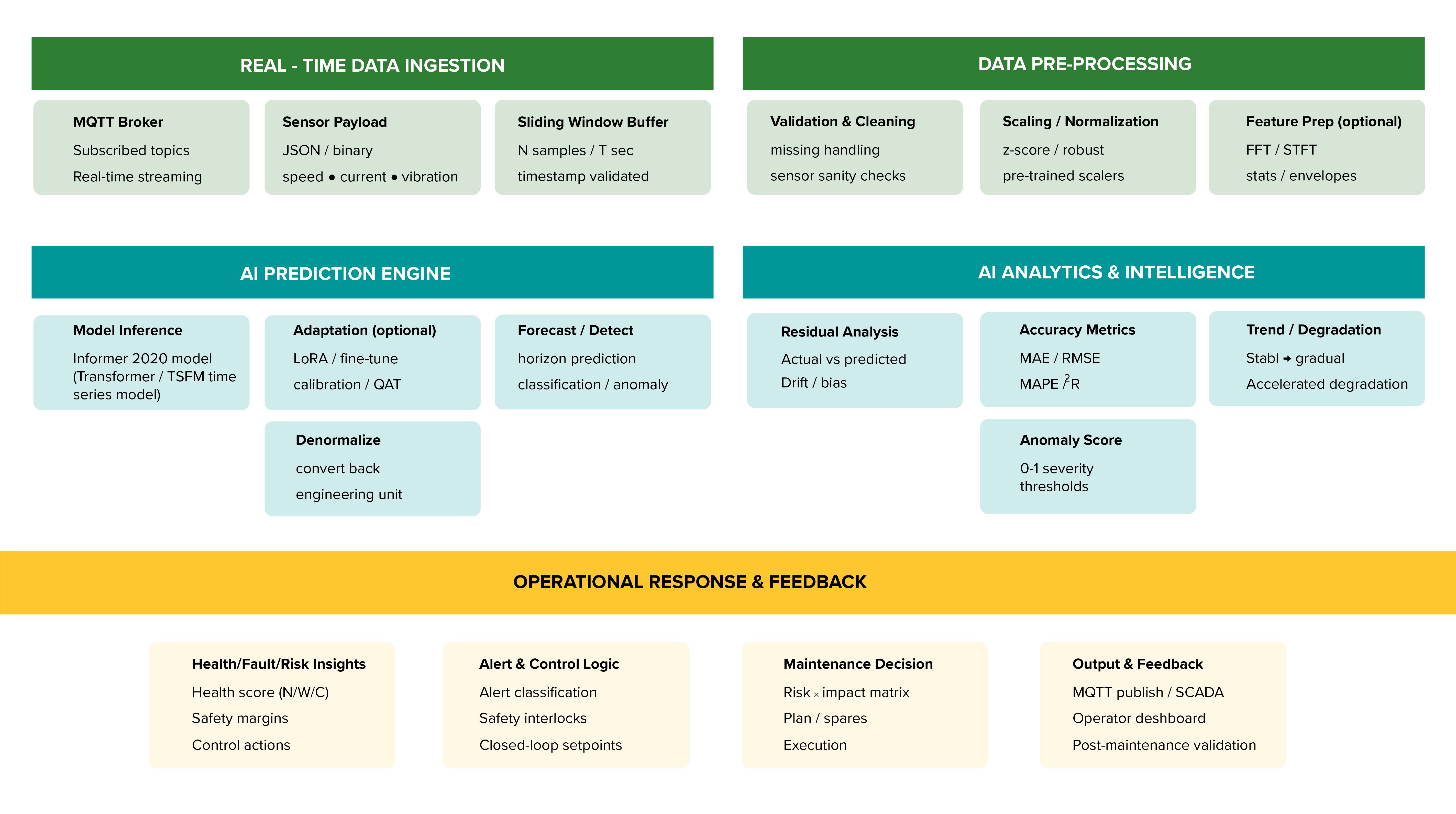
Predictive Workflow
Raw Sensor Data Acquisition
Telemetry inputs include temperature, speed, vibration, current, load, power, torque, and voltage.
Data Preprocessing
Cleaning, smoothing, normalization, outlier handling, and windowing.
Feature Extraction
FFT, STFT, RMS, and peak‑based enhancements for vibration diagnostics.
AI Model Inference
Transformer‑based forecasting, anomaly scoring, and trend evaluation.
Analytics
Residual scoring, drift detection, and degradation classification.
Operational Insights
Outputs are published to the dashboard via MQTT for operator decision‑making.
AI Engine Block Diagram
AI Engine Output
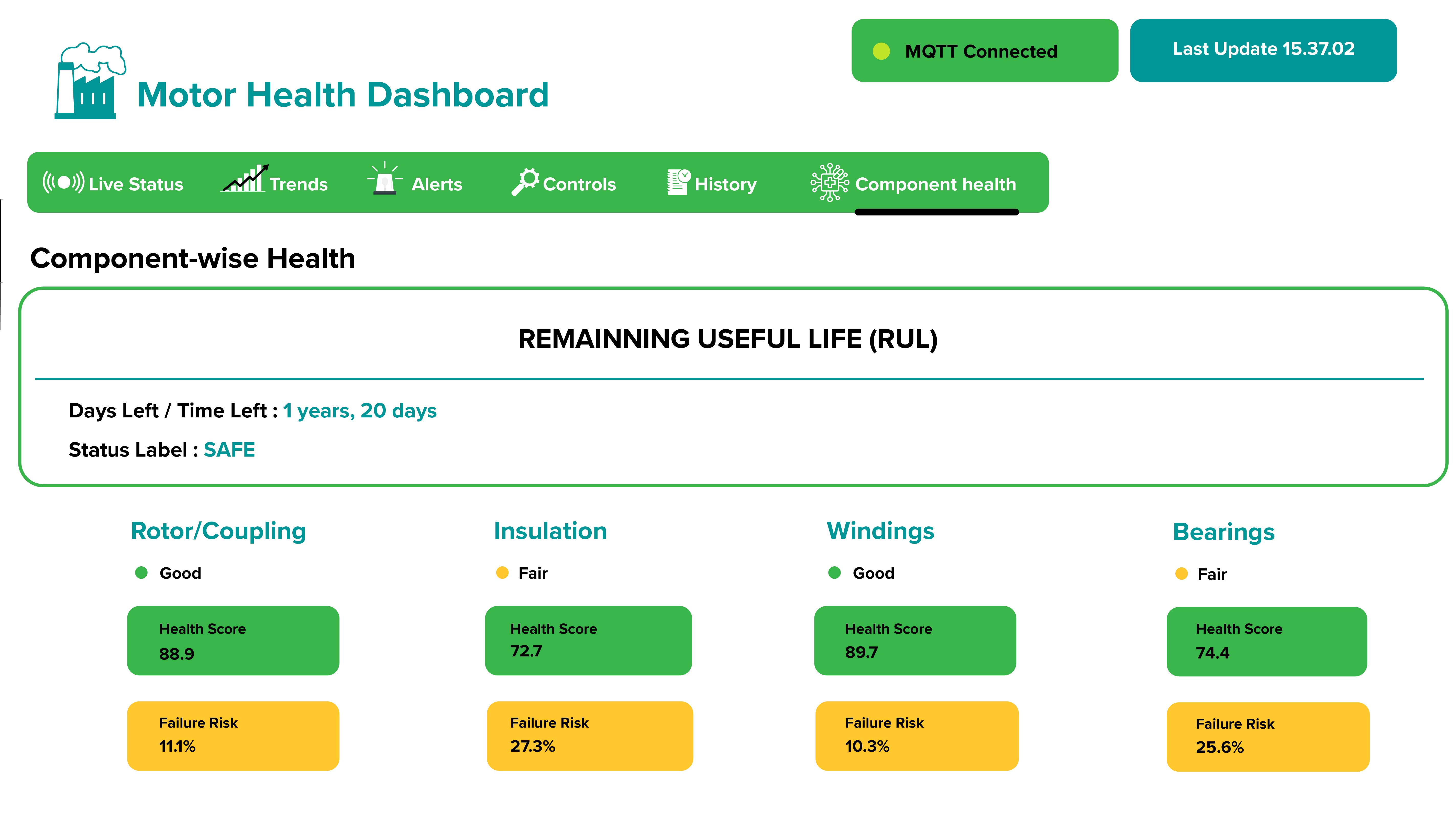
- Anomaly Detection: Measures deviation between predicted and actual signals, producing a severity index.
- Health Score (0–100): Aggregates thermal, electrical, and mechanical indicators.
- Remaining Useful Life (RUL): Estimates the time before maintenance is required.
Component‑Level Health:
- Bearings
- Thermal subsystem
- Electrical subsystem
- Mechanical load
Motor Health Monitoring Dashboard (Based on outputs of AI Engine)
Benefits
- Works reliably in offline/remote industrial environments.
- Reusable architecture enabling rapid implementation across multiple projects.
- High accuracy through optimized inference and fine‑tuning.
- Early detection of overheating, imbalance, electrical faults, and bearing wear. Improves operational safety and increases motor lifespan.
Use Cases
- Predictive Maintenance for Mission‑Critical Manufacturing Operations
In high‑throughput manufacturing environments, unexpected motor failures can lead to costly downtime and potential safety risks.
The edge‑deployed AI system continuously tracks motor operating behaviour and compares it against established baselines, allowing early identification of abnormal patterns. This enables maintenance teams to plan corrective actions in advance rather than responding after a failure has already occurred. - Reliable Motor Health Monitoring in Offline and Remote Industrial Sites
Many industrial locations operate in environments where reliable cloud connectivity is unavailable or not permitted.
This solution is designed to function completely offline, performing all data processing, diagnostics, and health assessment locally on the edge device. As a result, continuous motor monitoring is maintained without dependency on external networks, supporting reliability requirements for critical assets. - Energy Efficiency Optimization and Early Degradation Detection
The system monitors key operating parameters such as power consumption, torque, load, and vibration to detect early signs of performance degradation.
By identifying inefficiencies caused by mechanical stress, electrical imbalance, or thermal issues at an early stage, the solution helps reduce energy losses and ensures motors continue to operate within recommended performance and vibration limits defined by industry standards. - Decision Support for Maintenance and Reliability Teams
The monitoring dashboard presents motor health scores, anomaly severity levels, and remaining useful life (RUL) estimates in a clear and easy‑to‑interpret format.
This allows maintenance and reliability engineers to prioritize actions based on actual equipment condition, supporting informed decision‑making and consistent maintenance planning aligned with accepted asset management practices.
Challenges
- Handling noisy vibration signals requires advanced preprocessing.
- Noisy vibration signals require advanced preprocessing.
- Edge devices have limited compute capacity, requiring optimized models.
- Motor behaviour varies across Motor Types, demanding fine‑tuning.
- Integration with diverse PLCs, gateways, and register maps.
- Maintaining 24/7 reliability in harsh industrial conditions.
Conclusion
This industrial Edge AI approach brings together a robust local processing pipeline, optimized transformer‑based models, and predictive analytics to enable a shift from reactive to predictive maintenance. It provides a scalable, explainable, and future‑ready foundation for intelligent motor monitoring in modern industrial environments.

A Technical Manager specializing in embedded systems, IoT, and edge‑AI platforms for real‑world, large‑scale deployments across industrial and consumer electronics domains. He focuses on building secure, scalable, and maintainable systems while ensuring smooth execution from early concept to successful production rollout.
From a delivery and architecture standpoint, Suraj works across the entire product lifecycle—from requirements exploration and system design to implementation guidance, integration, validation, and release readiness. He has led end‑to‑end development for AI‑enabled smart appliances, industrial motor health monitoring platforms, secure IoT door locks, and large‑scale wireless controller systems operating in the field. His technical depth spans embedded and firmware architecture, BLE and Wi‑Fi systems, secure boot and OTA frameworks, and edge‑to‑cloud telemetry pipelines.
As a Technical Manager, Suraj brings a balanced perspective of architecture ownership and execution leadership. He works closely with cross‑functional teams to align technical decisions with delivery plans, manage risks early, and ensure quality outcomes. He is passionate about architectural thinking and engineering clarity—how clear requirements, clean interfaces, and strong design documentation enable predictable delivery, team autonomy, and long‑term system evolution. Through this blog, he shares practical insights from building and delivering real systems, lessons learned across full product journeys, and perspectives on scaling engineering practices for sustained impact.