

For decades, Design Thinking has been the backbone of innovation.
Five phases. Countless sticky notes. A methodology that’s helped teams build better products, smarter services, and more intuitive digital experiences.
But something significant is happening right now. Artificial intelligence is walking into each phase of this proven process and fundamentally changing how we work. Not replacing the framework, reshaping it from the inside out.
Here’s how it plays out, phase by phase.
The Five Phases: Overview
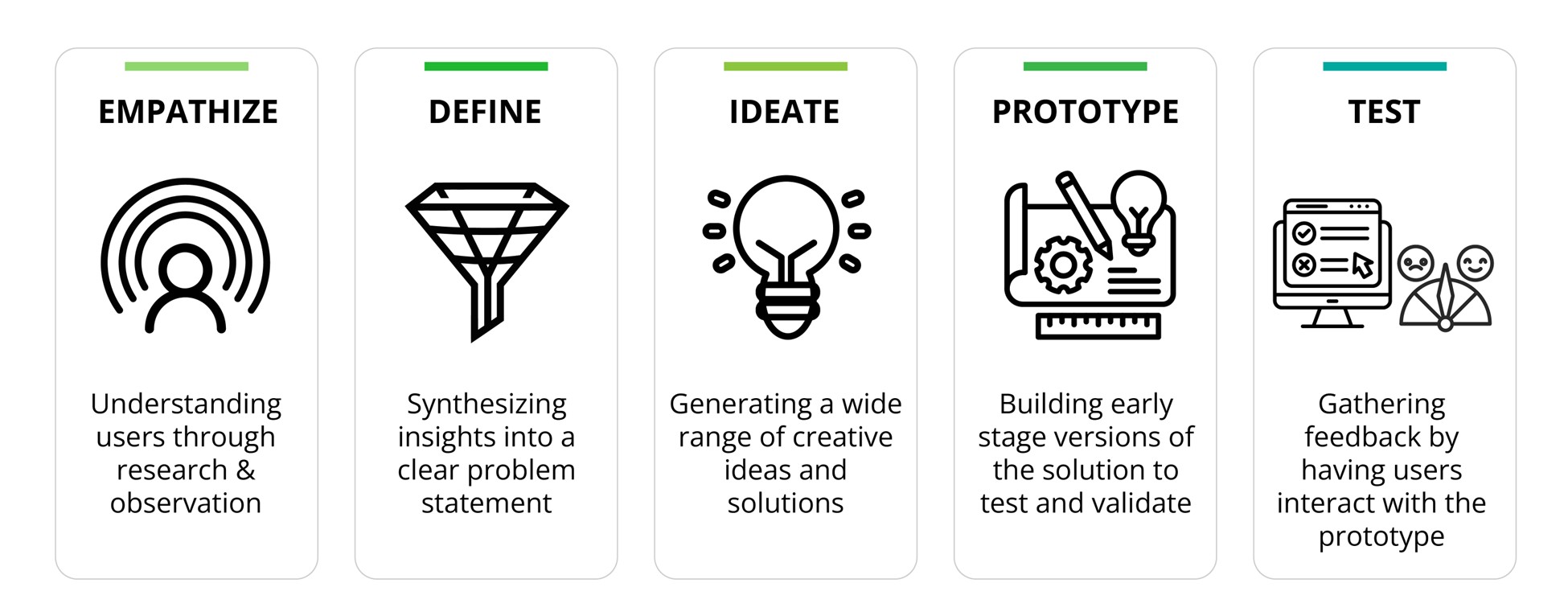
If you are newer to the framework, Design Thinking moves through five core stages
The methodology works because it keeps teams anchored in real human needs rather than assumptions. That’s exactly the foundation AI is now building on.
Phase 1: Empathize – AI Handles the Volume, Humans Hold the Conversation
Empathy has always been design thinking’s most important phase and its most time-consuming. Interviews, surveys, observations, and hours of manual analysis before a single insight is confirmed.
AI is changing the scale of what’s possible here. Sentiment analysis tools can now scan thousands of customer reviews, support tickets, and social media conversations in minutes, surfacing recurring pain points that would take a human team weeks to uncover. AI transcription tools don’t just record interviews; they tag themes, highlight emotional moments, and flag contradictions in what users say versus how they feel.
But there are still things AI cannot do: sit across from someone and notice the pause before they answer. Sense the hesitation behind their words. Build the kind of trust that makes people share what truly frustrates them and understand the weight behind the stories they tell.
AI processes empathy data. Humans create empathy. Use AI to handle the volume; invest your human energy in deeper, more meaningful conversations.
Phase 2: Define – From Data Chaos to Crystal-Clear Problems
You have gathered mountains of research. Now comes the harder part! making sense of it all without losing focus or falling into bias.
AI-powered tools like Miro AI and Dovetail can automatically cluster qualitative research into thematic groups, turning days of affinity mapping into hours. Feed your research into AI, and it can generate multiple problem statement drafts, giving your team a starting point to refine rather than a blank page to stare at.
Perhaps more importantly, AI adds a layer of objectivity. We all gravitate toward problems we personally find interesting, and our interpretations can subtly shift depending on factors like fatigue, pressure, or even the mental state we bring into the analysis. AI challenges those instincts by showing you what the data actually says.
That said, deciding which problem is worth solving still requires human judgment. Understanding business constraints, organizational readiness, and strategic timing, that’s context AI simply doesn’t have.
AI organizes the evidence. Humans make the call.
Phase 3: Ideate – Expanding the Possibility Space
Ideation has always been about exploring possibilities. But even experienced teams tend to generate ideas within the boundaries of their own knowledge and perspective.
This is where AI genuinely shines. Give it a well-crafted problem statement and it will generate dozens of approaches, some predictable, some bizarre, and occasionally one so unexpected it cracks your thinking open in a new direction. AI draws connections across industries and disciplines, borrowing solutions from fields you would never think of exploring.
Visual ideation has transformed too. Tools like Figma Make and UX Pilot can turn text prompts into concept visuals instantly, letting you explore aesthetic directions at a pace that simply wasn’t possible before.
But AI doesn’t understand why an idea matters. It can’t sense which concepts will resonate emotionally or feel authentic to your users’ lives.
AI expands the possibility space. Humans navigate it with taste and intent.
Phase 4: Prototype – Building at the Speed of Thought
Prototyping used to mean hours of pixel-pushing before you had anything worth testing. AI is collapsing that timeline dramatically.
Tools like Figma AI, UX Pilot, and v0 can transform text descriptions or rough sketches into functional interface designs within minutes. AI coding assistants can generate interactive prototypes from design files, meaning designers can build working concepts without waiting for developer support. Need to test three different navigation patterns? Generate all three in parallel and test them in the same user session.
The result isn’t just speed, it’s a fundamentally different relationship with iteration. You stop being precious about ideas because building and discarding has almost no cost.
But speed still needs judgment. A generated prototype can look polished while quietly missing important considerations, whether it is accessibility, clarity of a critical action, or the overall flow of the experience. AI can accelerate the act of building, but it cannot determine whether the solution truly works for the people it is meant to serve. The designer’s role is not just to prompt AI to build faster, but to guide what should be built and ensure the experience actually delivers value.
AI handles the construction. Humans ensure it’s worth building.
Phase 5: Test – Faster Feedback, Smarter Iteration
Testing has traditionally been the slowest phase, recruit users, schedule sessions, analyze results, synthesize findings, repeat. AI is compressing this entire cycle.
Behavioral analytics tools can now analyze facial expressions, mouse movements, and interaction hesitations in real time during testing sessions. AI can automatically identify patterns across multiple tests, flagging that 18 out of 20 users struggled with the same button, or that younger users navigated completely differently than older ones. A/B testing that once required weeks of data collection can now optimize dynamically, adjusting interface elements based on live user behavior.
But here’s what no algorithm can replicate – the moment a user says something that completely reframes your understanding of the problem. “I don’t want this to be faster. I want to feel confident I am making the right choice.” That insight doesn’t come from analytics. It comes from human conversation.
AI finds the patterns. Humans uncover the meaning.
The New Reality: A Partnership and not a Competition
AI is making the process of design thinking faster, more scalable, and capable of exploring a wider range of possibilities than ever before. It removes friction from the process so designers can focus on what actually requires human intelligence, empathy, judgment, creativity, and strategic thinking.
The five phases remain…
The stakes, however, are higher than they have ever been, because the tools are more powerful and the outputs more convincing. It can sometimes feel easier to move quickly and let the tools do most of the work. But the designers who will truly stand out are the ones who use AI’s speed as a springboard to think deeper, ask better questions, and create more meaningful solutions. Those who combine the power of these tools with strong human insight, curiosity, and responsibility will shape what great design looks like in the years ahead.

A Senior UX Architect with over 18 years of experience crafting user-centred digital experiences across products and platforms. He specializes in translating complex business and technology challenges into intuitive and meaningful solutions for users. Satya believes that great user experience comes from a blend of empathy, clarity, and practical thinking, and he approaches design as a way to simplify complexity and create experiences that feel natural and effective. He is particularly interested in how emerging technologies are reshaping the way digital experiences are designed and delivered.