

Supplier performance management was once treated as an operational imperative. Today, it has become a boardroom concern. As supply chains stretch across regions, regulations tighten, and customer expectations rise, procurement teams are expected to deliver more than cost savings. They are expected to ensure reliability, speed, quality, and resilience.
Yet most organizations still manage suppliers using static scorecards, periodic reviews, and manual analysis. These methods offer visibility but rarely provide time. By the time an issue appears in a report, the impact has already been felt on the shop floor, with customers, or on revenue.
This growing gap between visibility and action is where Agentic AI can make a difference by adding an intelligent layer to the automation.
What Is Agentic AI in Supplier Risk Management?
Agentic AI refers to AI systems that do more than analyze data. They observe continuously, reason across multiple signals, learn from outcomes, and act toward a defined goal: supplier reliability and risk reduction.
In supplier performance and risk management, Agentic AI acts much like a seasoned procurement advisor who never sleeps. It keeps a close watch on supplier behavior as it happens, bringing together operational data, financial signals, compliance indicators, and external risk factors into one clear view.
Rather than waiting for something to go wrong, it helps teams spot patterns early often before issues become visible disruptions. Simply put, it shifts procurement from firefighting problems to prevent them.
Why Traditional Supplier Risk Management Is No Longer Enough
Traditional supplier management systems tend to focus on looking backward:
- Did deliveries arrive on time?
- Were quality benchmarks met?
- Did pricing stay within agreed terms?
But procurement leaders today are asking tougher, forward-looking questions:
- Which suppliers might be under pressure right now?
- Where could risk be quietly building across tiers?
- If one supplier fails, how exposed are we?
Periodic reviews and rule-based alerts struggle to answer these. Supply chains move daily. Risks emerge across regions, systems, and partners. Static scorecards simply can’t keep pace.
From Automation to Autonomy: How Agentic AI Is Different
Automation has certainly improved procurement efficiency. Tools like RPA reduce manual work by handling invoices, extracting data, and updating systems. But automation follows instructions. It operates within predefined rules.
Agentic AI goes further. It continuously evaluates context, identifies relationships between signals, and adjusts as conditions evolve. Instead of reacting to triggers, it actively looks for early indicators.
| Traditional Automation | Agentic AI |
| Executes predefined rules | Works toward defined outcomes |
| Flags issues after they occur | Predicts risks before impact |
| Reviews data periodically | Monitors continuously |
| Requires manual interpretation | Requires manual interpretation |
This evolution from automation to autonomy gives procurement teams the confidence to act earlier and more decisively.
An Agentic AI supplier risk agent keeps track of performance indicators such as delivery reliability, quality trends, pricing adherence, financial stability, compliance posture, and broader market risks.
It draws from internal systems, ERP platforms, procurement tools, audit reports, and combines them with external data such as credit ratings, ESG records, news sentiment, and geopolitical developments.
What makes the difference is how these signals are connected.
A slight increase in delivery delays might seem manageable. A dip in liquidity alone may not trigger concern. But when these appear together alongside negative media coverage, they reveal a story that procurement teams need to see early.
The system presents these insights through intuitive dashboards, risk scores, and contextual alerts, helping managers adjust sourcing strategies or prepare contingency plans before disruption occurs.
What This Means for Procurement Leaders
With Agentic AI in place, supplier risk management shifts from a periodic, audit-driven activity to a continuous, learning system.
Here is a high-level reference architecture of how Agentic AI works 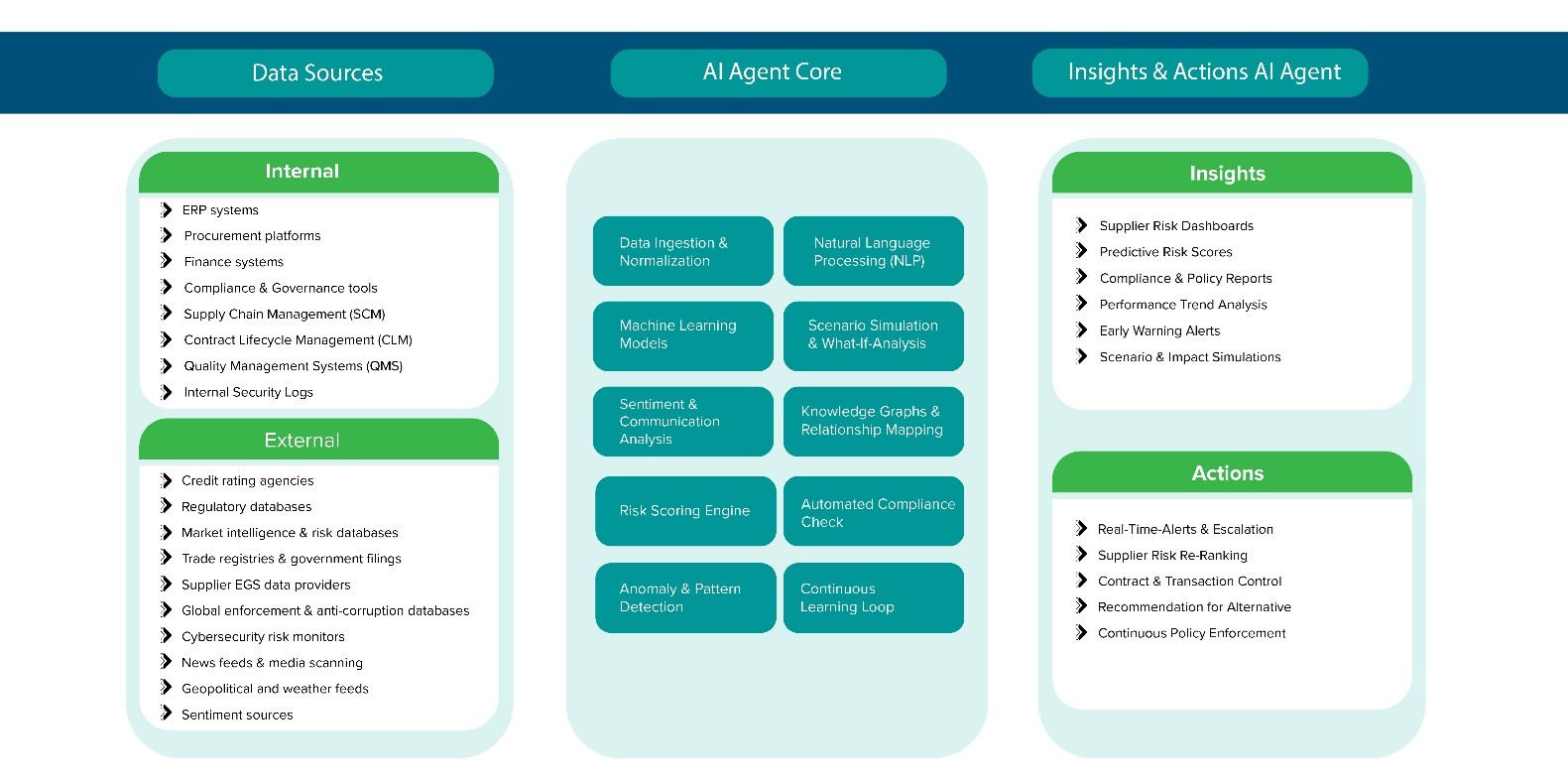
Organizations that embed Agentic AI into supplier risk management effectively can witness the following tangible outcomes
- 40–60% faster risk detection through incessant monitoring by the agent
- Lower supplier disruption rates due to early intervention
- Better compliance assurance through real-time automated validation
- Higher procurement ROI due to smarter sourcing decisions
What’s next?
The question all procurement leaders must ask is whether they are moving at the speed of modern risk formation or still relying on periodic reporting cycles, manual data consolidation, and isolated alerts.
Agentic AI will not replace procurement expertise, it amplifies it.
Managing complexity at scale and uncovering patterns that would otherwise remain hidden allows professionals to focus on strategy rather than chasing data. As supply networks grow more interconnected and risk becomes more distributed, manual reviews and static reports are no longer enough. The future of supplier risk management belongs to organizations that anticipate exposure before it affects operations, and Agentic AI helps make that shift real.

A Lead Business Analyst with more than 14 years of experience in business analysis and consulting within the Digital Process Automation (DPA) Center of Excellence at Happiest Minds. His expertise spans Agentic AI, process discovery, and automation strategy across diverse industries. Harshal has deep proficiency in RPA, low-code/no-code platforms, and enterprise automation frameworks, with a proven record of leading large-scale transformation programs and advising on automation governance and delivery excellence.
He holds a Postgraduate Diploma in Management and multiple professional certifications in Process Mining and RPA. Known for his analytical depth and practical insights, Harshal focuses on helping organizations unlock business value through data-driven process optimization and intelligent automation initiatives.