


Multicast is a way to efficiently send a single data stream to many destinations at the same time. Instead of sending multiple data streams to each destination, the network only replicates the data in the necessary parts of the network. This leads to optimal bandwidth usage and smooth scalability when there are many users who need the data.
We can harness the power of AI technology and convert the traditional multicast into Intelligent Multicast Networks that are capable of self-optimization, decision-making, and self-management.
The traditional multicast method, the role of AI, and the intelligent networking trends in the development of advanced multicast.
Understanding Multicast: The Efficient Alternative
Traditional multicast uses a multicast distribution tree. When a source transmits data to a multicast group, it sends only a single stream into the network. Routers along the path replicate packets only when necessary, forwarding them toward receivers that have expressed interest in that multicast group.
Protocols such as PIM construct a distribution tree rooted at a Rendezvous Point (RP) or at the source. This model provides a number of benefits like:
- Bandwidth Efficiency: Multicast eliminates redundant transmissions by allowing packet replication within the network infrastructure instead of at the source. This significantly reduces bandwidth consumption.
- Reduced Source Load: Since the source transmits only one copy of the data stream, the computational and networking burden on the source system is dramatically reduced.
- High Scalability: Multicast scales naturally. Adding more receivers does not proportionally increase network traffic, making multicast ideal for large-scale content distribution.
- Synchronized Delivery: Multicast allows for simultaneous reception of information by all receivers, a feature that is essential in various scenarios, such as broadcasting, financial trading, and software updates.
However, despite the various benefits that multicast networks offer, implementing such networks, especially on a large scale, is operationally complex. The operation of protocols such as PIM, IGMP, and multicast routing trees is difficult to plan and monitor. These difficulties, coupled with static routing decisions, provide opportunities for using artificial intelligence.
The Need for Smarter Multicast: Beyond Static Routing
Multicast protocol operation was initially designed when networks were less complex and more predictable. As a consequence, routing decisions are normally based on static metrics such as hop count or cost.
Although this has been effective in various scenarios, it is not sufficient in today’s networks that are characterized by:
- Cloud workloads,
- Rapid traffic fluctuations
- Highly distributed architectures
- Latency-sensitive applications.
This leads to several challenges like:
Limited Network Awareness
Routers typically make decisions based on local routing information. They lack visibility into global network conditions such as real-time congestion, link utilization, or application performance metrics.
Reactive Network Behaviour
Traditional multicast responds to failures or topology changes but cannot anticipate them. This reactive behaviour can lead to inefficient routing and delayed adaptation to traffic spikes.
Operational Complexity
Managing multicast across large enterprise networks or global data-centre fabrics is extremely complex. Manual configuration, troubleshooting, and optimization introduce the risk of human error and operational inefficiency.
Security Vulnerabilities
Multicast architectures can be susceptible to attacks such as source spoofing, unauthorized group joins, and traffic flooding. Without advanced monitoring and intelligence, detecting these threats becomes difficult. These challenges highlight the need for a more adaptive and intelligent multicast architecture.
How AI Reinvents Multicast: From Reactive to Predictive
- Artificial Intelligence and Machine Learning can assist in moving the network from static routing to predictive routing.
- Through the utilization of a large amount of telemetry data, Artificial Intelligence can understand network behavior, detect anomalies, and optimize routing strategies.
- The potential of this technology can be understood in the context of Multicast Traffic Engineering.
AI-Driven Multicast Traffic Engineering
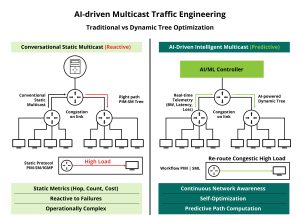
- Dynamic Tree Optimization
Instead of relying on static metrics, AI systems can continuously analyse network conditions and dynamically adjust multicast distribution trees.
AI algorithms can consider multiple real-time parameters including:- Link utilization
- Latency
- Packet loss
- Jitter
- Available bandwidth
Based on this analysis, the network can automatically select the most efficient paths and reroute traffic away from congested links.
- Predictive Path Computation Machine learning models trained on historical telemetry can forecast traffic demand and anticipate network events such as congestion or failures.
This allows networks to pre-calculate optimized multicast paths, ensuring smooth traffic flow even before disruptions occur. - Intelligent Load Balancing AI-driven traffic management can prevent network congestion by utilizing multiple paths for multicast traffic.By proactively managing traffic, AI can reduce network hotspots and improve the reliability and performance of bandwidth-intensive applications.
Advanced AI Use Cases in Multicast Networks
Beyond traffic engineering, AI unlocks a wide range of advanced capabilities in multicast environments.
- AI-Driven Quality of Experience (QoE) Optimization: 4K/8K streaming, VR/AR broadcasting etc. involve many applications that need to have stable performance. By using AI to analyze buffering events, startup latency, packet loss, frame drops and such values that are related to user experience, the network can dynamically change the multicast path or traffic prioritization to keep the best performance for all receivers.
- AI-Powered Multicast Security: Multicast networks present unique security challenges.
- Anomaly Detection/ Intelligent Access Control/ Threat Prevention: These models can identify abnormal behaviour as:
-
- Unauthorized multicast sources
- Unusual join/leave activity
- Traffic spikes indicating potential attacks
- The Infrastructure for Intelligent Multicast: Programmable Data Planes The required infrastructure for AI-based multicast is flexible. In this context, the programmability of the data plane, as is done in switches and SmartNICs, can be leveraged in such a manner that it becomes possible to control the data plane for the processing of packets using a programming language such as P4. Additionally, options such as Bit Index Explicit Replication (BIER) can be leveraged for the forwarding of multicast packets in a simpler manner without the need for maintaining any complex state in the routers. It is also possible that AI can be integrated into the network devices.
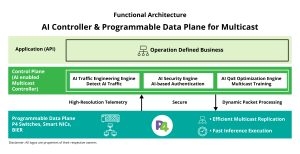
This capability enables several key innovations.
-
- High-Resolution Telemetry
Programmable switches can collect detailed flow-level telemetry data, providing AI systems with the rich datasets required for accurate learning and decision-making. - Dynamic Packet Processing
AI controllers can dynamically update packet-processing rules within the data plane, enabling real-time adjustments to multicast replication, filtering, and prioritization. - Efficient Multicast Replication
Technologies such as Bit Index Explicit Replication (BIER) simplify multicast forwarding by eliminating the need for complex per-flow state in core routers. Programmable data planes make it possible to implement these advanced mechanisms efficiently. - Edge-Level AI Inference
In certain scenarios, lightweight AI models can even run directly within network hardware, enabling ultra-low-latency decision-making at the packet level.
- High-Resolution Telemetry
Vendor Solutions in AI-Driven Multicast
Networking companies like Cisco Systems and Juniper Networks are using AI in their network management tools. For example, tools like Cisco DNA Center and Juniper Mist AI can analyze networks to improve visibility, anomaly detection, and even optimize paths within multicast networks. These tools, when used with SDN and programmable networks, can help create more efficient networks.
Happiest Minds Expertise in AI-Enabled Multicast Networking
Happiest Minds Technologies applies its expertise in SDN/NFV to enable organizations to design an intelligent multicast network solution using predictive analytics, network telemetry and programmable data planes to provide multicast traffic delivery optimization and enhance network performance capabilities to enable scalable multicast infrastructures that support the future needs of digital services.
Future Outlook
AI-powered multicast networks will help organizations achieve autonomous optimization, predictive congestion management, as well as security optimization. With the advent of emerging technologies like immersive streaming, real-time financial services, and large-scale digital events, intelligent multicast networking is expected to play an important role in the delivery of high-performance services.

Rupam is a Test Lead at Happiest Minds with extensive experience across Telecom (GSM, VoIP), L2/L3 Networking, and Embedded Systems. He specializes in Client-Server Architecture and Oracle databases, bringing a comprehensive full-stack approach to system validation.
With a powerful background in Python-driven automation, he focuses on designing robust frameworks for complex hardware-software environments. Throughout his career, he has successfully integrated domain knowledge with scalable automation strategies to ensure the reliability of critical infrastructure. His technical versatility and analytical skills make him a key contributor to the organization’s innovation and architectural excellence.